
To truly love, to love in a way that speaks to our highest potential and deepest need, one cannot help but veer into territory that may be called spiritual, that is, touching realms of selflessness, openness of heart, intuitive recognition, tenderness, care, and a willingness to understand, to go beyond self and ego, above all else. Yet these values are completely anathema to our normal developmental trajectory. We are taught and conditioned to be individuals, to be ambitious, to have goals, to demand our needs to be met, to fight for what we want, to dream and aspire for personal attainment and vindication. In basic terms, our world encourages us to form and reinforce a cult of self, where I am the main character and everyone else, indeed everything thing else, orbits around me.
What happens in relationships then? What happens when two (or more) mini cults decide to couple?
All to often it’s a fight to the death, though perhaps veiled in bargained niceties and socially sanctioned garb. The premise of what we call relationships in this world follows this strange, twisted logic: You give me what I want and I’ll give you what you want, and if it doesn’t happen there’ll be hell to pay. All’s well until the moment we don’t get what we want, when someone disappoints us, or when someone behaves outside of the scope of what is expected. Then the inner tyrant emerges, lashing out in primitive rage.
A major aspect of the self-structure includes unconscious beliefs of what we think relationships are for, as in what we expect and need from others. And we construct our lives, a kind of cult of self, in accordance with these needs and demands. We may believe we operate psychologically as a type of benevolent democracy. Yet if we are willing to look closely it is often more of the flavor of a totalitarian regime. Dictatorships are singular in their scope; tyrants do not need nor require equals. Yet we live under the illusion that we can effectively be with others while still operating from a state of mind that is all about me and my carefully constructed self-kingdom.
The truest truth is that what’s most meaningful about life, and therefore what’s most meaningful about our most meaningful relationships, is how we are with others, how we respond in the moments where life is asking us to step outside ourselves in service or for the benefit of someone or something else. In these moments we may be asked to lay aside our metaphorical swords as we come to see that our personal ideologies and fist-raising demands cannot withstand the call of Love, for it includes the other and leaves nothing out. We may disagree, perhaps vehemently, but the essence that unites us can never be extinguished. How could it be otherwise?
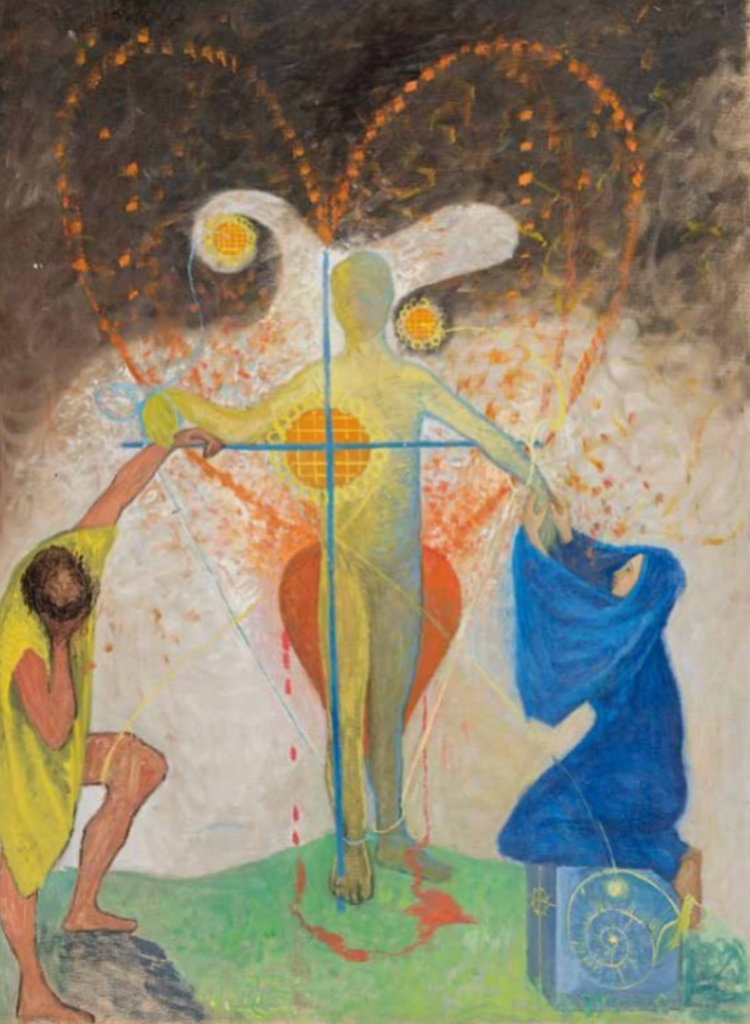
Art Credit: The Large Figure Paintings, No 2 (1907), Hilma af Klint
 Nick Bustos, PhD, LMFT